We are about to lose control of AI
The development is coming at us like a roaring tsunami. Yet in Norway, the debate is about the cultural elite's use of AI. Norwegian society can do better.

AI-generated illustration from Gemini.
Main moments
It is time to wake up. In Norway, the discussion is raging over whether authors can use artificial intelligence (AI) to write books. In Silicon Valley, the discussion is about how close companies are to automating AI research.
This could lead to an explosive acceleration of AI development. Ever-improving AI systems could build increasingly capable AI models at an accelerating pace. No one knows what the future holds. But if these companies succeed, we cross a threshold into the unknown, where humanity risks losing control over its own trajectory.
The AI company Anthropic writes in a report from this summer that "we may cross this threshold within the coming year." OpenAI issues the same warning.
The trend is clear
The companies are speaking to us from the future. They have access to vastly more powerful models than the ones available to the public. However, they also have financial incentives to hype their own products. That is why the recent report from the research organization METR is worth noting, offering a rare independent glimpse inside Anthropic.
The conclusion after three months of fieldwork at the company is that their AI progress on well-defined tasks has doubled, and that the development in model capabilities is exponential. About 80 percent of the progress is due to AI making research more efficient.
We are still some way off from AI leading AI research, but the trend is unmistakable. Anthropic reports that the share of R&D work (research and development) where AI plays a significant role surged from 1 to 26 percent between March and August of this year.
If recent years have shown anything, it is that once AI gets a grip on a discipline, it does not take long to go from underperforming humans to outperforming the world's best. A couple of years ago, models struggled with grade-school math. Today, they are solving previously unsolved math problems that the world's leading mathematicians have spent decades trying to crack.
Needs neither sleep nor breaks
What AI needs to master a field is for problems to be broken down into verifiable components that models can practice on through countless iterations. AI research appears to possess these very characteristics. It is a digital domain with clear metrics for success. Companies understand the mechanics of this research intimately, because much of it takes place in-house.
We should expect irreversible breakthroughs inside companies before we observe major effects in the economy. We therefore cannot rely on the labor market to give us the first warnings of what is about to happen.
When the changes come, they will come very fast. AI agents work many times faster than humans and can be spun up in large swarms that do not need sleep, breaks, or years of investment in education.
Will be able to perform all white-collar jobs
Analysts at AI Futures estimate a 65 percent chance that AI will surpass the best human AI researchers by the end of 2027. By the following year, they expect it to be a coin toss whether models will have advanced enough to handle all white-collar jobs. Other experts doubt things will move that fast. Still, the massive investments pouring into companies like Anthropic suggest investors have lofty expectations for how many jobs can be automated.
Accelerating AI development increases the risk that we will lose control. Existing control mechanisms and international frameworks are not adapted to a situation with extreme growth in AI model capacity driven by AI-led AI research.
Anthropic admits in its own risk report that current safety measures are insufficient. Even if companies manage to prevent catastrophic accidents, they still run the risk of displacing humans as the dominant thinking force on the planet.
We are facing a scenario where billions of AI agents in a data center could constitute a larger cognitive workforce than an entire nation's portfolio of smart, highly educated people. If companies and states can obtain expertise without humans, how long will we continue to invest in them?
China is catching up
It is difficult to see how we will control the development, not least from little Norway. Donald Trump and the US are obsessed with winning the AI race, motivated by the idea that whoever controls superintelligence will dominate the future. The companies themselves fuel this narrative: If we don't build it, someone else will, and it is better that "the good guys" at Anthropic do it than companies controlled by the Chinese Communist Party.
This logic has a grain of truth. But the situation is more like a man on water skis behind a boat speeding forward, where the boat driver says they must go faster and faster because the man on the water skis is right on their heels and will zoom past if they slow down.
The US is driving the speedboat, and China is waterskiing right behind. They are learning from American breakthroughs. The faster the pace of development, the greater the risk that they steal the models. Security across these companies has tightened, yet Anthropic concedes that no AI company—including itself—can defend its models against state-sponsored actors.
The Government Pension Fund Global should have a plan
Stopping automated AI research is the single most important step humanity can take right now. This is not unthinkable. It might make sense to slow down, even for the Americans. China lacks computing power and will take time to catch up with the American lead.
A halt in automated AI research requires insight into and verification of what companies are doing. METR was allowed inside, but Anthropic has prevented the public from assessing the most important evidence. At a minimum, leading AI safety institutes, such as the British one, must be given access.
We must also build preparedness for explosive scenarios for the labor market, democracy, sovereignty, and security. The Government Pension Fund Global is positioning itself to buy into AI companies when they go public. The fund should have a plan for how its ownership power will be used.
At the same time as the development is coming at us like a roaring tsunami, the AI debate in Norway is about the cultural elite's use of AI. Norwegian society can do better. It is time for the debate to grasp the world-historical challenge that an automation of AI research actually poses.
More from Langsikt

Lay aside the AI-indignation
It will take time to form good habits for AI use for individuals and society. Along the way, we must be wary of the self-righteous indignation spreading among Norwegian authors.

Input for the new AI strategy
Long-term input for the new AI strategy.

The government should change its stance on data centers
If we can offer the industry speed and predictability, we can demand more in return.
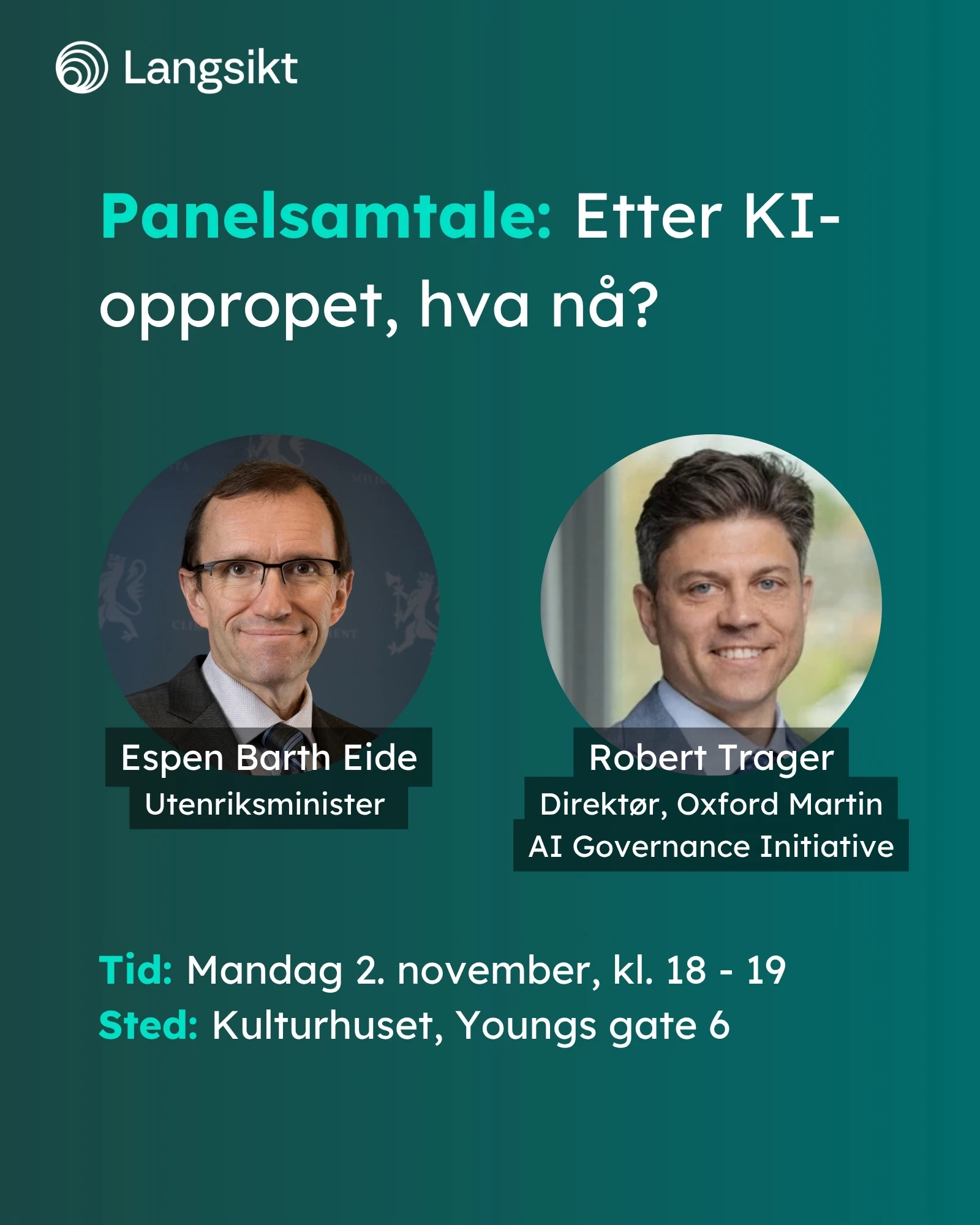
[Recording] After the AI call, what now?
Watch the recording of the panel discussion on AI between Foreign Minister Espen Barth Eide and Prof. Robert Trager.