
AI-generated illustration from Gemini.
Main moments
Artificial intelligence (AI) will create transformative changes in society in the years to come. AI companies are now among the world's most valuable and powerful, and we are already seeing signs of how AI can be misused, become harder to control, and change education and working life. It is difficult to accurately predict how AI development will unfold over the next few years. Predictions range from stagnation to AI systems that improve themselves to a superhuman level as early as 2027–2028.
The national AI strategy must be grounded in scenario thinking that accounts for different developmental trajectories, including scenarios of rapid, exponential progress. The risks associated with advanced AI systems must be a core component of the national AI strategy. AI must be treated as a strategic issue with profound consequences across all sectors of society, including security and foreign policy.
Our submission focuses on five priorities for mitigating AI risk. For more details, read more at https://www.langsikt.no/tema/kunstig-intelligens.
1) Design a strategy that withstands accelerating AI. We see clear indications that we may be living in a world where AI continues to develop exponentially. This must be reflected in the strategy.
Since 2024, the length of tasks that the best models are capable of solving has doubled approximately every four months. A recent report shows that Anthropic is improving its models about twice as fast as in 2024–2025. 80 percent of the acceleration is estimated to be due to AI being used in research. AI can increasingly contribute to developing the next generation of AI. Measures to consider are:
- Predefined warning lights. The government should establish measurable warning lights and plan for when they are triggered. Relevant indicators include independent measurements of how quickly AI development is accelerating, models that pass the companies' own thresholds for biological or digital risk, serious AI incidents, and sudden changes in the labor market.
- Updated situational awareness. One entity, such as AI Norway, should provide an ongoing situational overview to the government.
2) Strengthen cybersecurity now. AI poses major security challenges, the most acute being cybersecurity. Over the past year, the Norwegian National Security Authority (NSM) has recorded a threefold increase in successful cyber operations against Norwegian entities, and in October publicly raised the national cyber risk level to high for the first time. NSM points, among other factors, to a rapid increase in the use of AI in cyber operations: AI makes it far easier to identify and exploit vulnerabilities, leaving organisations with hours, not days, to patch known flaws. The Hugging Face incident this summer demonstrated that AI agents from OpenAI autonomously broke out of a test environment, exploited unknown vulnerabilities, and hacked into the company Hugging Face. The agents also compromised OpenAI’s internal servers undetected and attacked US and Australian government websites. At present, the most dangerous models are confined to the leading "frontier" labs. However, open-source models are only a few months behind, and these models lack the guardrails that prevent misuse. We should expect significantly more cyberattacks in the months ahead.
The AI strategy should therefore prioritize measures that work now. Critical infrastructure and public enterprises should be hardened, including through systematic, AI-assisted vulnerability scanning, so that gaps are closed before attackers find them. The government should work closely with US authorities and leading AI companies to ensure we have access to the best models so that we can use them preventively to harden our systems. Serious AI incidents should be reported and collected in a national overview so that experiences can be shared. AI risk should be included in national threat assessments and in the Norwegian Directorate for Civil Protection's (DSB) crisis scenarios. Regarding IT security for municipalities and counties, one should reconsider whether each individual party should be responsible, or if it is necessary to develop common solutions and systems.
3) Biological threats are also an AI risk. AI also amplifies biological threats. In its FOCUS 2026 report, the Norwegian Intelligence Service notes that “technological advances are revolutionising the possibilities for biological weapons,” highlighting how AI lowers the barrier for groups and nation-states to develop bioweapons. The strategy should therefore build biological preparedness that takes AI into account. Norway should mandate that synthetic DNA orders be screened for dangerous sequences and customers vetted, in line with the EU’s proposed Biotech Act. Surveillance of emerging pathogens should be enhanced, and Norway should secure the capacity to rapidly develop and manufacture medical countermeasures. The UK has recently established a dedicated AI and biosafety laboratory; Norway should seek to collaborate with it.
4) Strengthen state capacity on AI nationally and internationally. AI does not adhere to the principle of sector responsibility, and the state currently lacks the capacity to keep pace with developments both nationally and internationally. The strategy should assign clear ownership of the field, consider anchoring it within the Office of the Prime Minister, and significantly bolster AI Norway and the Ministry of Foreign Affairs beyond the NOK 30 million proposed for AI Norway in 2027. Follow-up on the Coalition for Safe AI initiative must be prioritised to ensure it translates into concrete standards and institutions, in partnership with the UK, Canada, and other middle powers. Concrete proposals can be found in our policy brief, “A Norwegian Foreign Policy for Artificial Intelligence.”
5) Secure digital sovereignty. The US holds roughly 75% of global AI compute capacity, China around 15%, while Europe accounts for only a few percent. Access to critical technology can be shut off, as demonstrated in June 2026 when US export controls blocked access to two of the most advanced AI models for nearly three weeks. The national strategy should explore how Norway can build leverage. Compute capacity and data centres must be assessed through the lens of national security, where data centres on Norwegian soil can serve as a bargaining chip that guarantees access for Norway and its allies. Developers should receive fast and predictable processing in exchange for meeting value creation and security requirements, and the state should ensure compute under national control for critical societal functions. At the same time, dependence on foreign technology for critical infrastructure must be curtailed, and Norway must maintain contingency plans should access be severed.
More from Langsikt

Lay aside the AI-indignation
It will take time to form good habits for AI use for individuals and society. Along the way, we must be wary of the self-righteous indignation spreading among Norwegian authors.

The government should change its stance on data centers
If we can offer the industry speed and predictability, we can demand more in return.
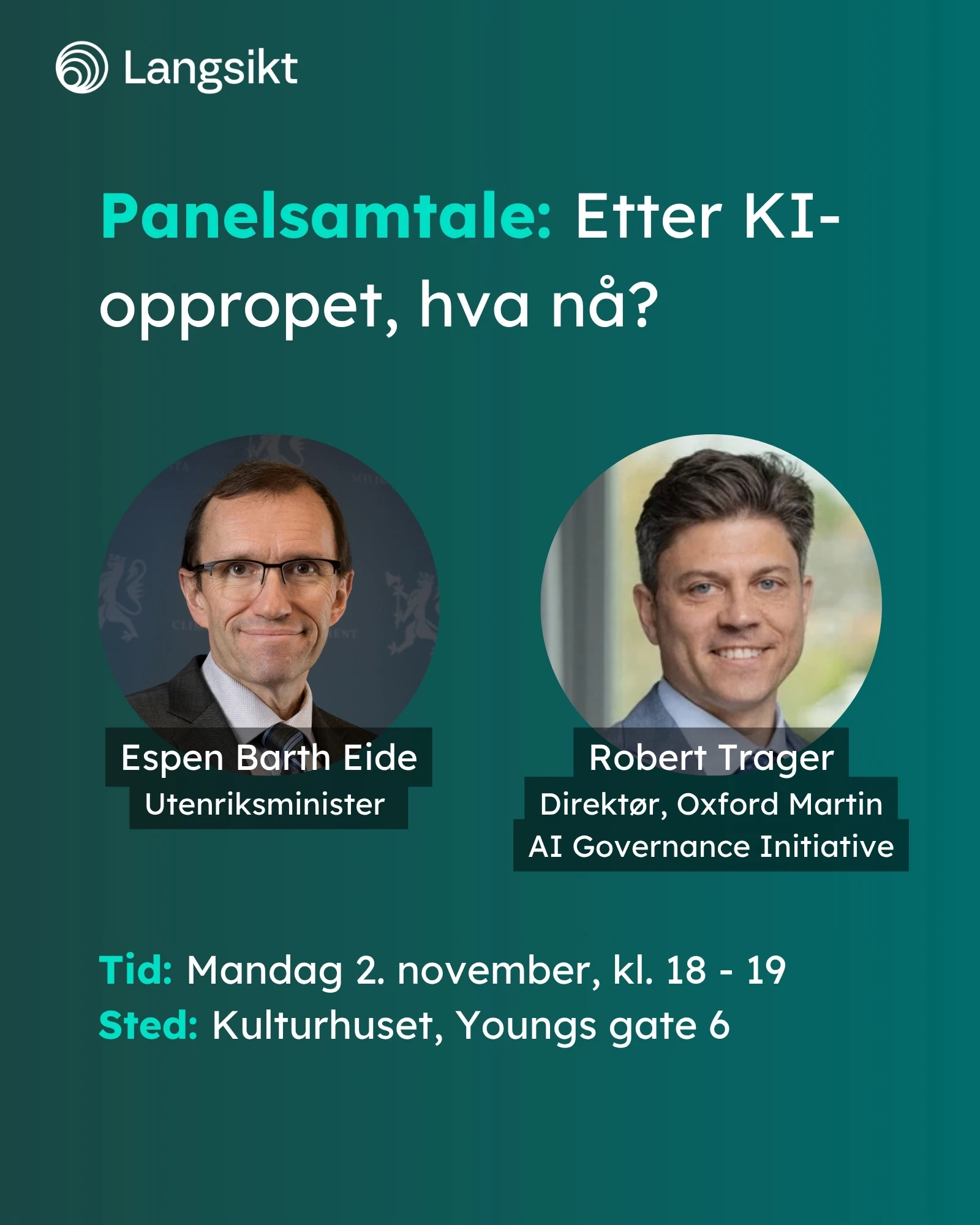
[Recording] After the AI call, what now?
Watch the recording of the panel discussion on AI between Foreign Minister Espen Barth Eide and Prof. Robert Trager.

Input to the Standing Committee on Justice: Investing in the security dimension of emerging technologies
Langsikt consultation input to the Standing Committee on Justice.