Lay aside the AI-indignation
It will take time to form good habits for AI use for individuals and society. Along the way, we must be wary of the self-righteous indignation spreading among Norwegian authors.

AI-generated illustration from Gemini.
Main moments
Following revelations of extensive AI use in Jørn Lier Horst's books, the author has become the first victim of AI outrage in Norwegian fiction. The backlash is completely disproportionate to the crime. And it remains unclear what that crime actually entails.
One argument is that AI use makes text worse. The author lets the chatbot do the work. It may be efficient, but the text becomes monotonous, impersonal, and lacks nerve.
A tool that contributes to lower quality must, of course, be discarded. But if AI writing always produces inferior results, most authors should avoid it like the plague. Those who do not will lose in the competition for readers and recognition.
Blaming AI is beside the point anyway. There are countless ways a text can turn out poorly. It is better to criticize the final product for being substandard than to attack one possible cause.
A more important point is that it is unlikely that AI-generated text always makes the writing worse. It is more likely that those who get caught are simply the ones who are worst at using the technology.
Those developing guidelines for AI use must recognize that the technology is advancing rapidly. Just a few years ago, AI models couldn't solve middle school math. Today, AI outperforms our best minds in mathematics. It would be foolish to assume that AI will always make for a poor co-author.
AI doping
Aftenposten commentator Ingunn Økland raises a more compelling argument: that using AI is a shortcut—a form of technological doping.
The problem with doping is that it undermines the purpose of sports: physical mastery. Likewise, the craft of writing can be said to be a form of intellectual mastery, which is undermined by AI assistance.
In fact, the doping argument is stronger for AI writing. If authors get AI to write the entire book for them, they are no longer participating in the purpose of writing. Conversely, there is no drug that could make it easy for Lance Armstrong to cycle up the French mountains in pursuit of the yellow jersey.
Still, we shouldn't push the point too far. Authors can rely on human assistants for research, feedback, and even drafting sections of text. Yet we wouldn't claim that writers receiving such support are acting against the very purpose of literature.
It is the same with authors who get help from AI. Horst or others who use AI to write books do not say "write me a book" to ChatGPT. The chatbot is an assistant or co-author. We need an explanation of why AI assistance is a greater breach of the purpose of writing than human assistance.
Perhaps the answer lies in a more specific view of literature's role: as an effort to convey the human experience. According to influencer Sophie Elise Isachsen, a machine can never authentically capture genuine human experiences. Thus, text generated by AI compromises the very essence of literature.
But this view underestimates the extent to which language models are grounded in human experience. Not from one human, but from the vast majority of humanity's collective text production. A kind of collective art, if you will.
A doping regime causes great harm
We are concerned that an AI ban will inherit the worst of the doping regime without significant gains. In sports, only a few of those who dope are caught. Yet, we ruin the lives of those who are.
We will see the same in the field of writing. Those foolish enough not to cover their tracks will be held up to ridicule. Those wise enough to generate text with one model and remove the traces with another will avoid the pillory.
It will take time to form good habits for AI use, for individuals and society. Along the way, we must be wary of the self-righteous indignation spreading among Norwegian authors. Much harm has been done in the name of the good. AI-indignation is no exception.
More from Langsikt

Input for the new AI strategy
Long-term input for the new AI strategy.

The government should change its stance on data centers
If we can offer the industry speed and predictability, we can demand more in return.
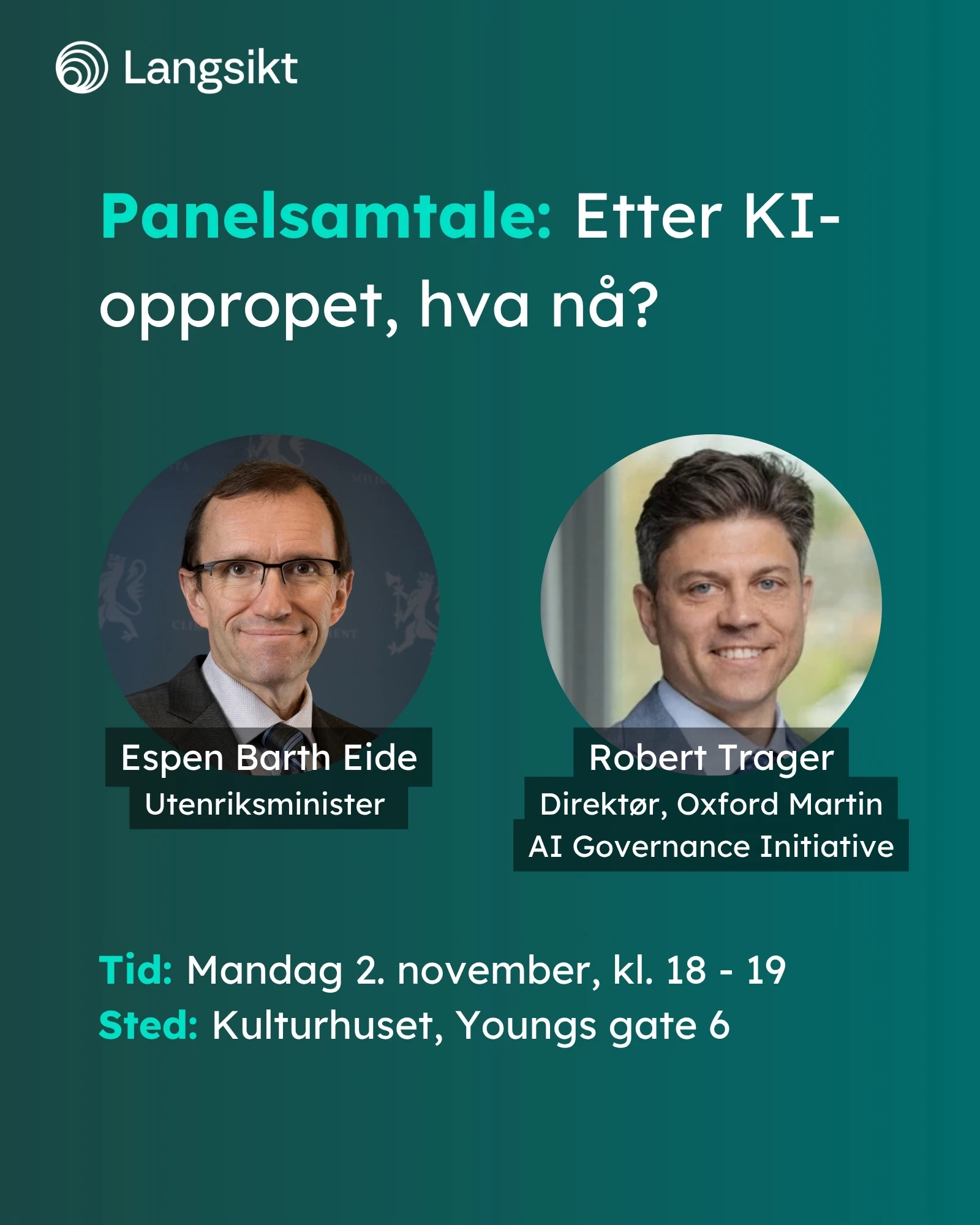
[Recording] After the AI call, what now?
Watch the recording of the panel discussion on AI between Foreign Minister Espen Barth Eide and Prof. Robert Trager.

Input to the Standing Committee on Justice: Investing in the security dimension of emerging technologies
Langsikt consultation input to the Standing Committee on Justice.