What will happen to the jobs?
Framework for understanding KI's effect on the economy.
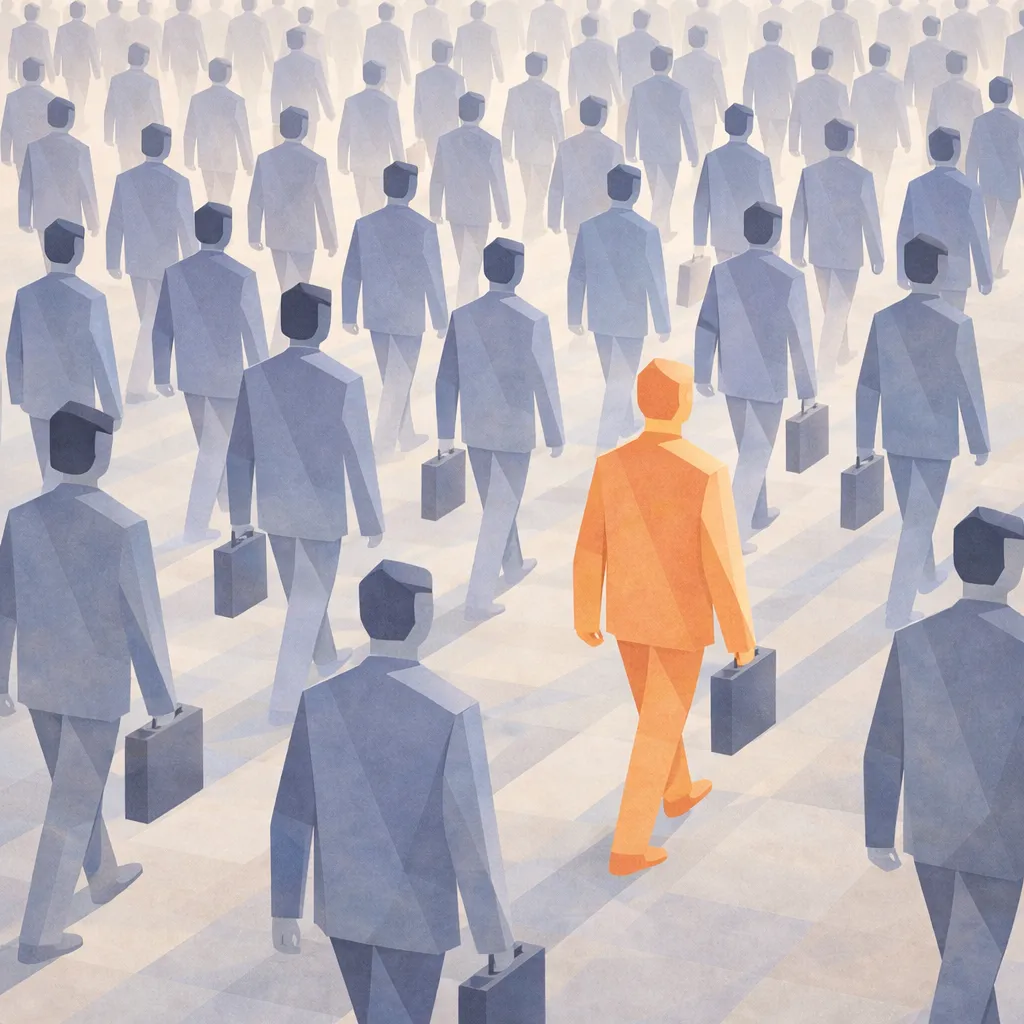
Ki-generated illustration from Sora
Main moments
Download to read the full note. Please note the policy note is in Norwegian, reach out to kontakt@langsikt.no to request an English version.
In this note, we present a framework for understanding how artificial intelligence (AI) can affect the Norwegian economy. The framework summarizes the most important mechanisms in the research literature and focuses in particular on the effects that KI can have on productivity and workers' health. The aim is to provide policy makers, students and community stakeholders with a better basis for understanding the mechanisms through which KI can work, which assumptions are central to the economic models used by leading experts and thus an understanding of why different expectations about the impact of AI on the economy diverge.
Background
The development of artificial intelligence is proceeding at a tremendous pace. Several models do just as well on standardized tests as experts with PhDs. Agentic models allow increasingly complex and extensive tasks to be solved by KI. Several experts believe development will continue at the same pace and that we can reach artificial general intelligence (KGI) within a few years. Others think development could slow down. Nevertheless, there is broad agreement that KI may have significant impacts on the economy, including for growth, jobs and income distribution.
Economists' models nevertheless give very different predictions about how CI will affect the economy. A somewhat pessimistic estimate is found in Nobel laureate Daron Acemoglu. In a 2024 paper, he assumes that about five percent of tasks in the U.S. economy will be automated in the next ten years. This increases GDP by about 0.9—1.6 percentage points compared to a scenario without CI, with an uncertain effect on inequality. A more optimistic estimate can be found in Philippe Aghion, one of this year's Nobel laureates. He shows that more or less full automation of the economy can lead to a growth explosion in which wages fall drastically and inequalities become very large.
The main reason for the models' different predictions is different assumptions about how large a portion of the tasks in the economy that will be automated in the years ahead.
One type of study tries to estimate how many of the tasks in the economy are may are automated, usually with today's KI models. For example, a study from SSB estimates that about 17—18 percent of tasks in the Norwegian economy can be automated with current AI technology. The study shows that professions such as programmers, payroll workers and accountants are most exposed to automation, while more physical work such as construction work and cleaning can be automated to a small extent with current technology.
That a task in the economy may Automated does not mean that staying automated. Companies will only choose KI over workers if it pays off. Daron Acemoglu, for example, expects that only a quarter of the Ki-exposed tasks will be profitable to automate within the next ten years. The SSB study, on the other hand, estimates that time spent on tasks exposed to generative KI can be reduced by around 50 percent.
Structure of the note
Part 1 presents the background and summary of the report.
Part 2 of the note presents the framework for how KI can affect the economy. We start by presenting the framework of an individual business, illustrated with a stud operation. We then address the framework at the community level. We present and discuss the key effects KI can have, such as the replacement effect, reinstatement effect, scale impact, ripple effects in the economy and the need for readjustment, the baumol effect and endogenous growth. How KI works overall, and whether employment increases or goes down, depends on which of these mechanisms predominates. We also discuss how KI can affect the distribution of income in the economy, including wage differences, wealth inequality and the distribution between workers and capital owners' share of income.
Part 3 of the note reviews what prerequisites must be met in order for KI to automate a larger number of jobs in the years to come. In order for AI to automate tasks, it must be both possible and profitable. We describe the conditions that make automation possible, such as technical limitations, people's preferences for interacting with people, politically determined laws and regulations, as well as what can prevent automation with AI from becoming profitably, although it is possible.
This note omits some topics that are also important in the debate about KI's impact in the economy. Among other things, particularly Norwegian conditions are not treated as the Norwegian model of working life to a special extent. The memo also does not discuss the possibility of changing the direction of technological developments, which several prominent economists are concerned about. Important challenges of political concentration of power, the intersection of economics and geopolitics, challenges to democracy, as well as more philosophical questions such as the importance of work in people's lives and possible challenges of commodification of social relations, are also omitted. Nevertheless, we hope that the memo can help to enlighten the conversation about how KI can affect the Norwegian economy. Good read!
More from Langsikt

Confused about the AI threat?
Recent events have made AI risk a topic of public debate in Norway. Some researchers issue strong warnings, others claim they see doomsday on the horizon, while others dismiss the whole thing as marketing campaigns. This document summarizes what we know, what is disputed, and what the implications of this uncertainty are. The document can also be downloaded as a PDF.

A Norwegian foreign policy for artificial intelligence
Why and how Norway should position itself in a new security policy reality.

Konseptnotat for et norsk KI-sikkerhetsorgan
Hvorfor og hvordan Norge bør etablere et KI-sikkerhetsorgan.

The wave of hacking is coming
Until now, small Norwegian businesses have been protected by the fact that no one bothered to hack them. That is changing with open AI.