The Great AI Liberation Is a Practical Contradiction
Losing people the work, we also lose the ability to introduce schemes that ensure people an income to live on. The dream that machines can liberate humans by taking over all work is therefore not possible.

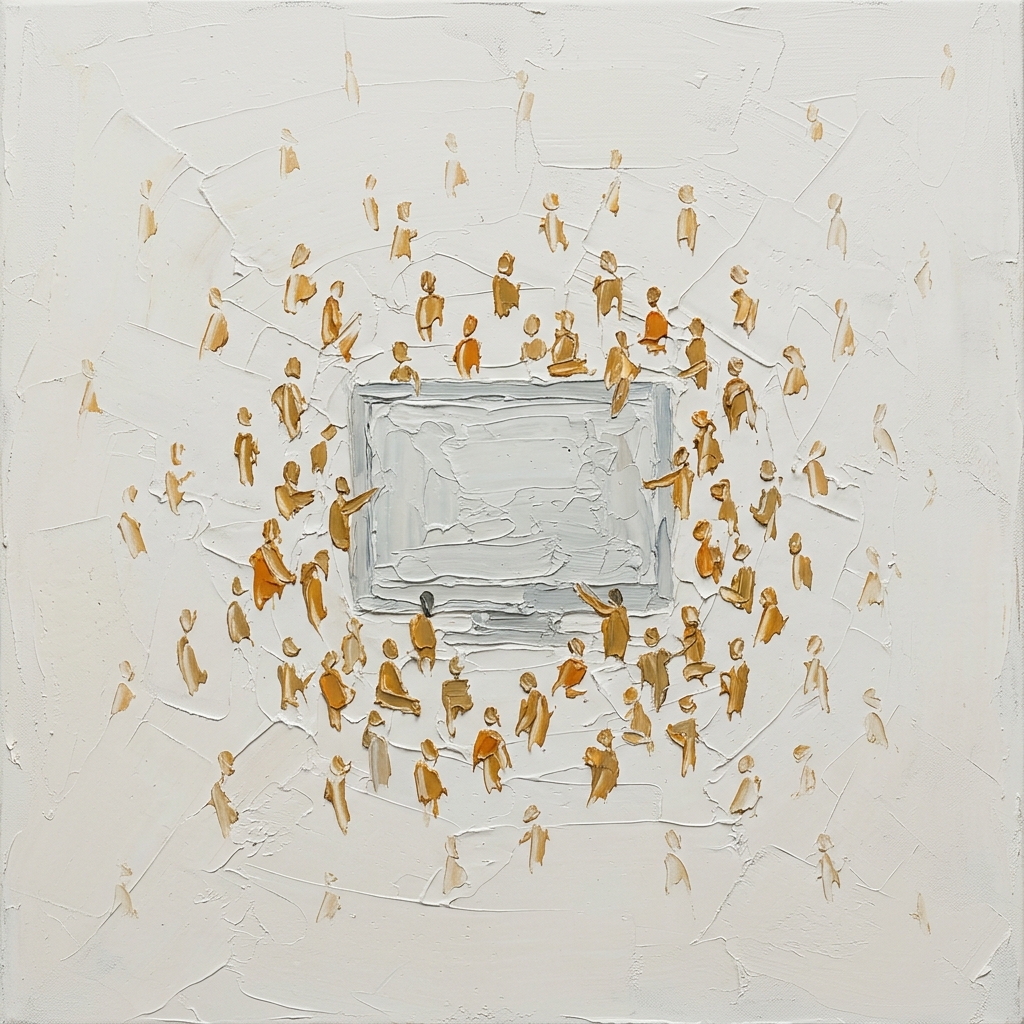
Ki-generated illustration from Gemini.
Main moments
“Civilization needs slaves,” writes Oscar Wilde in The Soul of Man Under Socialism, but the slaves must be machines, not humans. The boss of OpenAI, Sam Altman, seems to share Wilde's idea. He believes the company's vision of developing “highly autonomous systems that outcompete humans in most economically valuable work” is the path to a future where”Alles life [can] be better than someone's life is today“.
But if the machines replace labor, how are the great unfortunates to be able to live good lives? It is unlikely that the machines will create”fully automated luxury communism“, which gives everyone what they want without having to pay for it. Machines must have wages in the form of computing power and other capital costs. And if history has shown us, it is that humans have a remarkable ability to develop new needs when the original ones are satisfied.
In order for a world where machines do the work to be good, we need a redistribution mechanism from owners of capital to those who can no longer make a living from work. More specifically, we need an unconditional basic income that goes to all citizens, regardless of work or previous employment, as advocated by Altman in the essay”Moore's Law for everything“.
The proposal is realistic in the sense that a society that has automated all work can afford to fund a generous basic living wage. However, a closer analysis of the conditions for the introduction of redistributive policies shows that the idea is a practical contradiction.
The political power relations necessary for the introduction of the basic wage are undermined by the technology-induced unemployment that makes the citizen's wage necessary.
Automation undermines people's power resources
Our argument is, in short, that lasting and substantial redistributive policies only come to fruition when it is incumbent on owners to share the resources. In other words, those who profit from the redistribution must possess power resources, that is, resources that cause others to act in one's interest.
Here's the problem: when machines take over work, humans also lose their most important resource of power, the labor necessary for both value creation and protection of the country. Once that resource of power is gone, people will have little hope of gaining traction for a significant redistribution of resources in their favor. The moral and political duties of elites to those who are worse off will not protect a people without power.
How can we say anything meaningful about a future so different from our own, where super-intelligent AI systems have created mass unemployment? The best thing we can do is learn from history. More specifically, we need to look to history to be able to establish what conditions must be met to achieve lasting and significant redistribution in a situation of significant inequality and private property rights.
There is, in any case, one such institution that we can draw lessons from: the welfare state. During the early phases of the Industrial Revolution, working people were extremely vulnerable to income loss and exploitation. During the twentieth century, however, welfare states were created to ensure income security related to unemployment, sickness, and old age, and basic services such as education, health, and elder care. These schemes ensured a stable and robust form of redistribution from those who are better off to those who are worse off.
If we understand the conditions that made it possible to create and safeguard welfare states, we will be able to assess whether the citizen wage will make Wilde and Altman's utopia a reality.
Welfare State Explanations and Implications for Basic Income in an Automated World
There are many explanations for the emergence of the welfare state: (1) the working class material power pushing forward schemes the capitalists don't want, (2) employers' interest in safe, healthy and competent workers, (3) workers' need for collective insurance (which they pay for themselves) (4) the working class political power pushing forward schemes the capitalists don't want and (5) Elites' fear of revolutionary currents. We consider the explanations in turn and consider their implications for whether a citizen's salary can realistically be introduced in a situation where machines have taken over the work. We start with those explanations that give the most pessimistic estimates.
(1) Dependence of capital on workers
One explanation highlights the importance of the economic and military power of the workers. Workers are needed both in production and in the fight against internal and external enemies. Through organisation, strikes and the threat of laying down arms, workers can put “power behind the demands” of employers and political elites and thus push forward schemes that favour them, such as generous welfare schemes.
This addiction explanation is bad news for the dream of a citizen's wage. If welfare schemes are a product of the ability of workers to withhold labour, we would also not expect that the basic rate of living wage will be introduced when people no longer work. Then they have no manpower to withhold nor the necessary resource of power to force the elites to listen.
(2) Common interest between workers and capitalists
The reliance on workers has also given rise to a more harmonious explanation highlighting the employers as important drivers of welfare reform. According to this explanation, one doesn't have to rattle with the sabers to put in place welfare schemes. Indeed, it is in the interest of many employers to support government programs that invest in workers' education, health and other welfare, because these benefits increase the human capital of workers, which in turn makes them more productive.
Nor does this harmonious explanation bode well for our scenario. If welfare schemes are introduced because employers need competent labour, there won't be a basic living wage in a situation without workers. If people are no longer needed as workers, it also makes no sense to invest in their human capital. We should therefore expect little support for the most important source of education—education— in a world where workers are no longer needed. Adam Smith and Karl Marx's common concern about the undermining of workers' faculties by capitalism as a result of routine work may here, paradoxically, stem from the fact that human labour is no longer needed.
(3) The welfare state as insurance
Another explanation that highlights harmony between peoples is the social insurance explanation, promoted among others by Kalle Moene. According to this explanation, the welfare state is largely an insurance scheme that workers pay for themselves. Both the working class and the middle class are vulnerable to unexpected income lapses and unwanted expensive life events, whether desired or undesirable. Income protection and tax-funded services provide an insurance against life's many risks. Had the workers not had an income to insure or an income to pay the insurance premium with, we wouldn't have welfare states either, according to this explanation.
The social insurance explanation gives a hope that the basic salary will be introduced in the face of full-scale automation. If the vast majority can expect that their job will be performed by a machine, that is something they benefit from insuring against. The winners, those sitting on the ownership of the dominant KI systems, will pay, while the losers, those who no longer have work, will receive a generous citizen's salary.
One challenge is that it's not a given that people will grasp the seriousness until it's too late. When the house burns, it's too late to buy fire insurance. It is also not a given that the necessary majority for a citizen's salary will be formed. With a gradually rising unemployment rate, it could create huge disparities between those on the inside of the labour market and those on the outside, where an ever-smaller group of wage earners will object to paying for an increasingly expensive citizen's wage scheme.
A more fundamental problem is that insurance schemes rely on an enduring uncertainty about who are winners and losers. The welfare state relies on the next generation of workers seeing themselves served by the scheme. The day the welfare state goes from being an insurance scheme and becomes a mere transfer from the contributors to those who do not contribute, the danger is great that the system unravels.
(4) The political power of the workers
A fourth explanation highlights the political power of the workers. Through political organization, the people can fight for redistributive reforms. This power-resource theory, developed by Korpi and Esping-Andersen, has long been the leading explanation in welfare state research and explains why Scandinavia has the most generous welfare states.
This explanation is more promising. Apparently, people want both the time and strong interests in getting a citizen's salary implemented. There should therefore be hope for them to coalesce in a political fight for higher taxes and a citizen's wage. One problem is that placing huge tax burdens on a small minority may be easier said than done. In today's welfare states, it is essentially the workers themselves who pay for the welfare schemes that serve them. Large transfers by capitalists are limited by two factors: their ability to move capital between borders and that taxes on capital weaken the economy's ability to grow in the long run.
More seriously, political power is probably dependent on economic power. If it was only bad advice and vulnerability to fluctuations in income and expenditure that determined, one should expect those who were permanently out of work to be at the forefront of the fight for welfare reform. But it was workers who championed the welfare state reforms.
In fact, there is reason to believe that democracy itself stands and falls on the power resources of the people. Not all countries in the world are democracies. And where democracy arises, it is often linked to the fact that the elites of a country depend on the broad stratum of the people.
Middle-class property owners pushed for the right to co-determination to ensure the protection of their own property and the opportunity to conduct trade. The elites in turn depended on the activities of the middle classes to survive. Another factor was the elites' reliance on the masses to act as soldiers.
Democracy, in turn, was expanded when the working class championed both welfare schemes and expanded voting rights. The day the elites of a country are no longer dependent on the labor and trade of its people, there is also no reason to believe that it will survive as a democracy. At least we've never seen this before in the long history of civilization.
(5) The elite's fear of the revolutionary masses
A final explanation is the elite fear explanation. An effective way to get elites to impose policies for the benefit of the masses is to threaten to overturn the societal order from which the elites derive their power. Bismarck is the clearest example of elites introducing people-friendly policies to stem revolutionary currents. Less well known is, as Magnus Bergli Rasmussen and Carl Henrik Knutsen show, that fears that the Bolshevik revolution would spread to Norway caused Norwegian conservative elites to support proposals such as the eight-hour day. It is better to give a little, was the thought, than to lose everything.
Elite fear is apparently a plausible mechanism for introducing a basic living wage in a situation of mass unemployment. A horde of unemployed people is likely to be willing to support revolutionary leaders who promise better terms. Civil wages can thus be a cheap way of passifying the masses compared to the chaos, terror, expropriation and executions that will come if the people turn against the small elite of capitalists.
The problem with this expectation, is that the KI that is advanced enough to automate the bulk of work is also likely to be advanced enough to crack down on insurgencies and control the population effectively. This could be done through much better surveillance, large-scale manipulation campaigns, autonomous drones that can crack down on demonstrations and other things that are difficult to predict in advance.
For a threat to be credible, people must have both the will to revolution as well as the resources of power. And if those resources of power are neutralized by effective KI technology, the elite have no reason to give in.
Conclusion
Summa summarum, there is little reason to believe that a robust and generous basic rate of living wage will be introduced in a situation of mass unemployment.
What follows from this? First, that the defenders of the Ki utopia cannot show that the common hop will be better off in anticipation as a result of technological developments. The whole rationale for developing automated AI, despite the risks, rests on the fact that the gains will benefit everyone. But if technology itself undermines the conditions of the redistribution that is supposed to ensure this, the rationale falls away. It's like sawing over the branch you're sitting on.
Second, we should rethink the “create, then share” strategy, where we will first develop the technology, and then sort out the allocation issues afterwards. This is turning things on their head. The more advanced the technology becomes, the more difficult it will be to ensure the redistribution of the grounds outlined above.
Third, the analysis points to the need for a worker-friendly technological development. Not all artificial intelligence replaces labor. A lot of KI makes workers more productive without making them redundant. Such “labor-enhancing” technology can bring huge gains without undermining the conditions for sharing them. The choice between labor-paying and labor-enhancing KI is not fated. It's a political choice we can influence, as Acemoglu and Johnson point out in the book Power and Progress.
Oscar Wilde's dream of mechanical slaves freeing humanity is beautiful. But the dream overlooks that liberation requires more than pure technological development. It also calls for power to ensure an improvement for everyone in a radically different world with new power structures. Without that power, automating KI won't lead to liberation, but the opposite.
More from Langsikt
Confused about the AI threat?
Recent events have made AI risk a topic of public debate in Norway. Some researchers issue strong warnings, others claim they see doomsday on the horizon, while others dismiss the whole thing as marketing campaigns. This document summarizes what we know, what is disputed, and what the implications of this uncertainty are. The document can also be downloaded as a PDF.

A Norwegian foreign policy for artificial intelligence
Why and how Norway should position itself in a new security policy reality.

Konseptnotat for et norsk KI-sikkerhetsorgan
Hvorfor og hvordan Norge bør etablere et KI-sikkerhetsorgan.

The wave of hacking is coming
Until now, small Norwegian businesses have been protected by the fact that no one bothered to hack them. That is changing with open AI.