Langsikt's alternative aid budget
How the Norwegian aid budget should look.
AI-generated illustration from Gemini.
Main moments
Summary
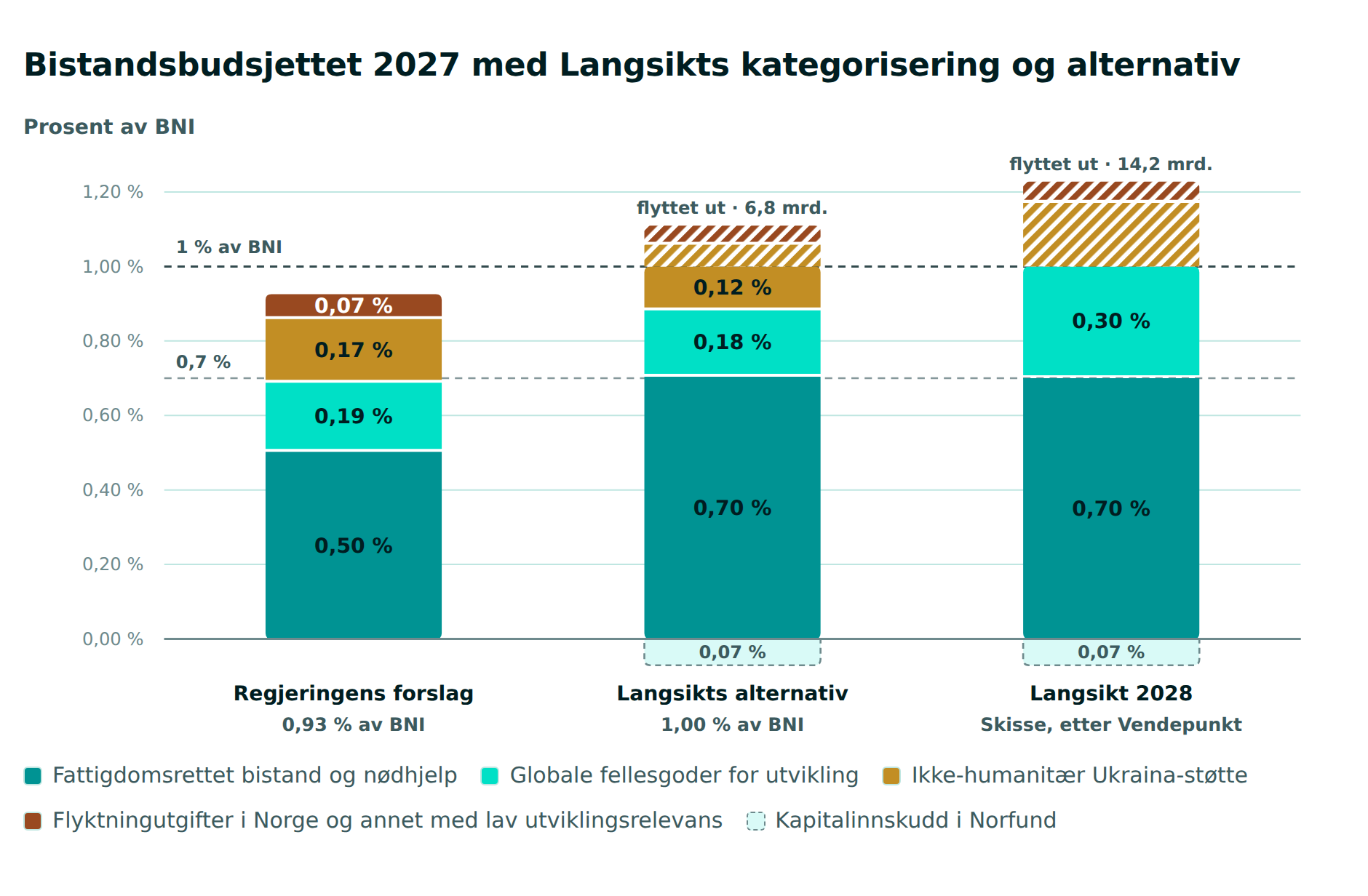
In the government's proposed aid budget for 2027, only 0.50 percent of gross national income (GNI) is allocated to poverty reduction and emergency relief. The total budget is 57.6 billion NOK, or 0.93 percent of GNI.
One-third of the government's proposal is allocated to Ukraine and refugee measures in Norway. Of Norway's total support to Ukraine, 15 billion NOK is counted as aid, even though only a quarter of this is humanitarian aid. The rest is primarily operational and energy support for the Ukrainian state and should be financed outside of the aid budget. Currently, this support is crowding out other aid.
The world's poorest are receiving less and less. Several budget items aimed directly at the poorest have remained stagnant or have been cut for several years in a row. Support for initiatives such as health, education, and food security has been reduced. It is no longer clear what the primary purpose of aid is.
Langsikt proposes earmarking 0.7 percent of GNI for poverty reduction and emergency relief. We also propose that at least 0.3 percent of GNI should go toward global public goods for development. The total aid framework would thus still amount to at least 1 percent of GNI. This restructuring is achieved through a cleanup of the aid budget: some items are cut, some are moved to the budgets of other ministries, and capital injections are no longer counted as aid.
We prioritize reaching the 0.7 percent target as early as 2027, while the 0.3 percent target will require until 2028. We are moving only one-third of the non-humanitarian Ukraine support to the defense budget in 2027. By moving the remainder in 2028, there will be room for more global public goods for development. Together, these measures will help restore the original purpose of aid and achieve far more good for those who need it most.
Download to read the full report.
More from Langsikt
The second problem with aid
Much of the pressure on foreign aid comes from the outside. But we must take some of the blame ourselves.
Submission to Project Turning Point (Prosjekt Vendepunkt)
Six proposals for Project Turning Point.
Aid on whose terms?
Ocean-related aid is spread thinly across many projects and countries. It is therefore not a solution to the fragmentation in current aid, as the Institute of Marine Research claims.
Not everything that creates jobs is aid
The most interesting thing Minister of International Development Åsmund Aukrust (Labour Party) said on Dagsnytt 18 almost went under the radar. He stated that development policy is more than just aid.